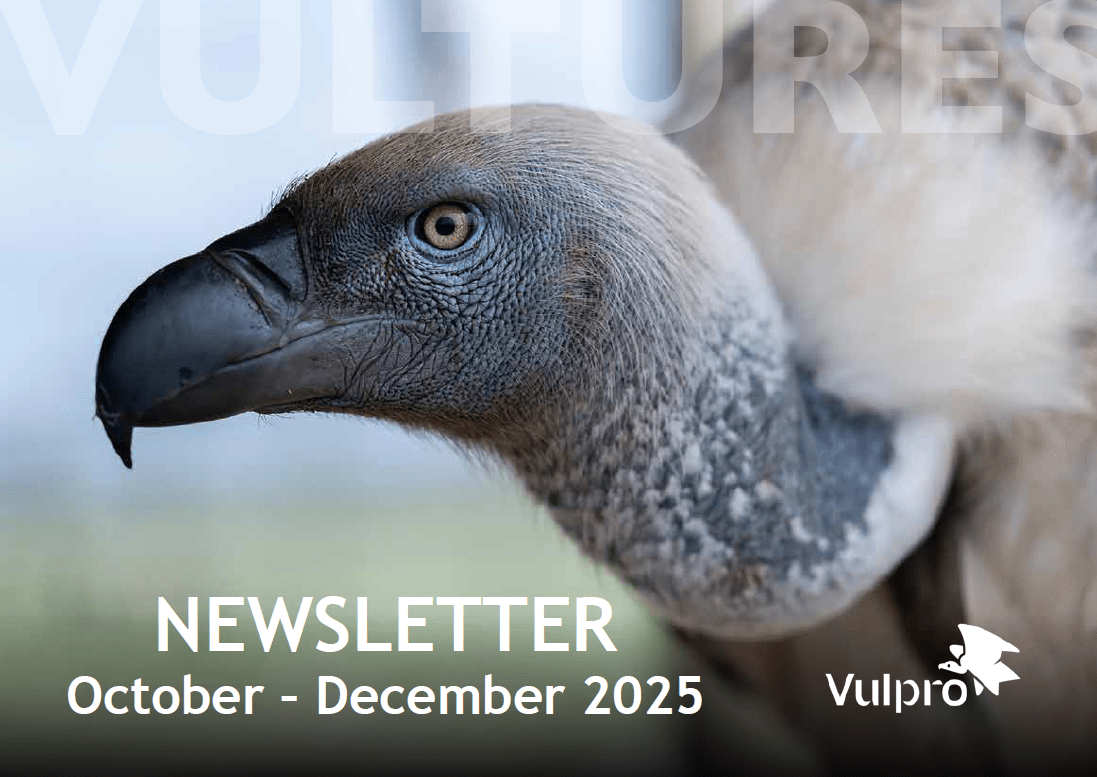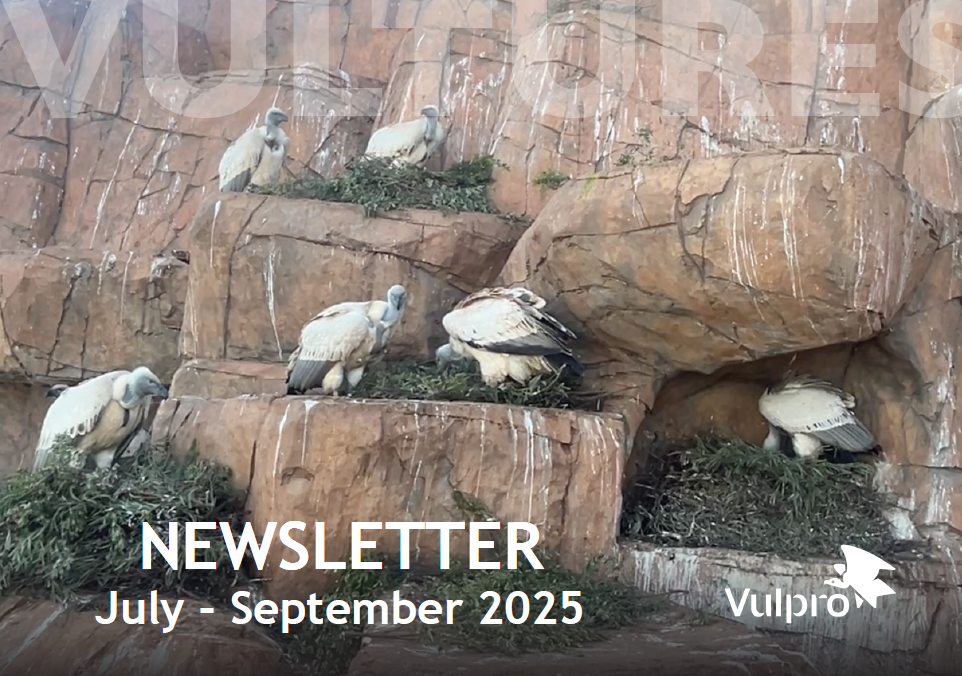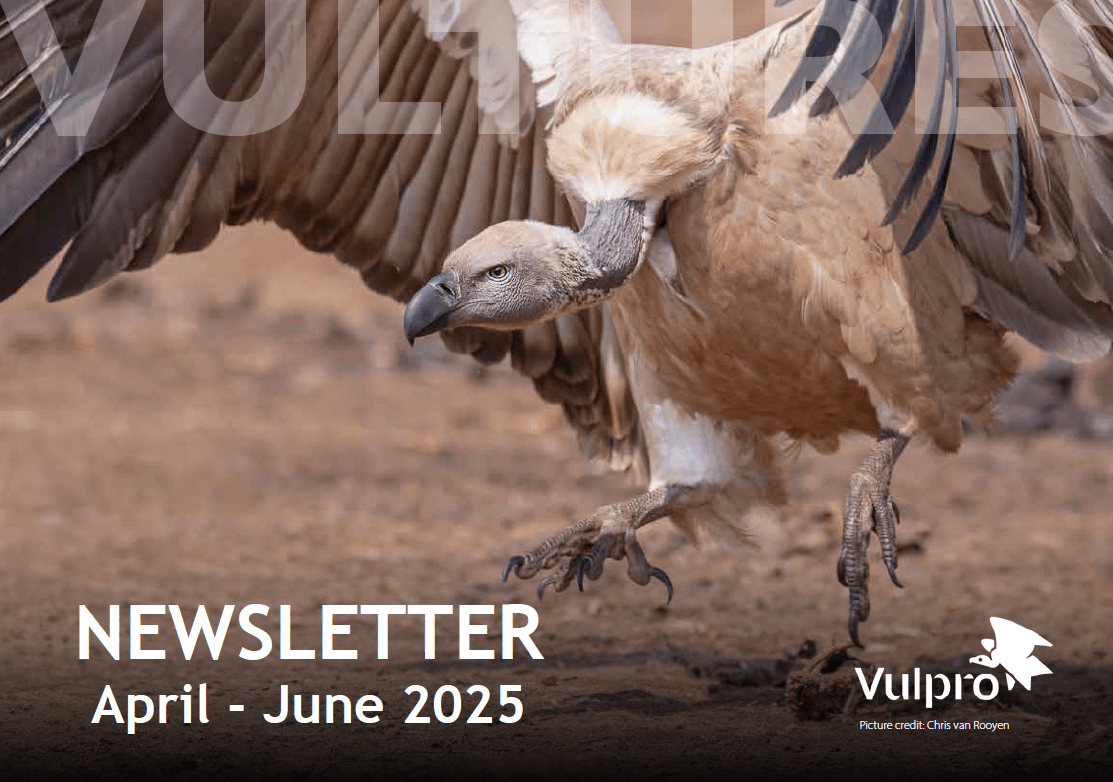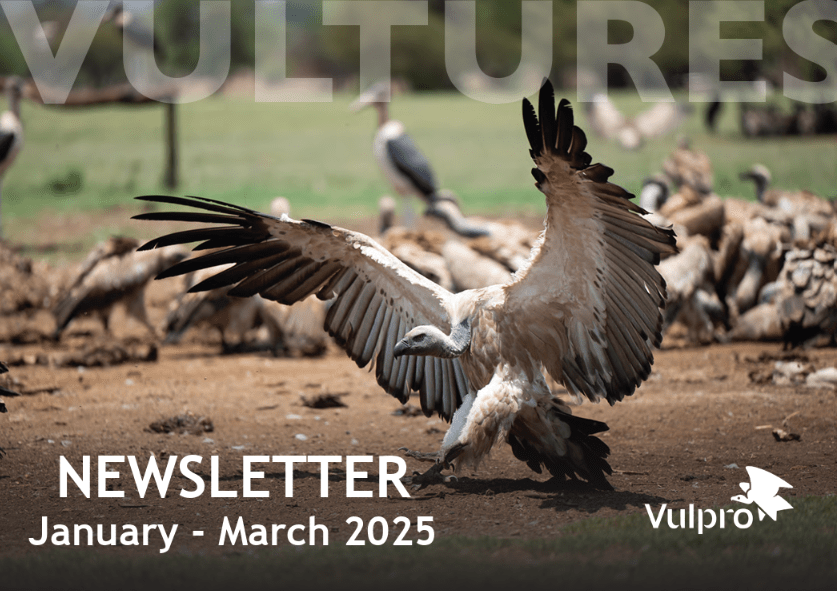
Newsletters

Annual Reports

2025 Annual Report

2024 Annual Report
2023 Annual Report

Protocols

Cape Griffon Vulture Colony Monitoring Protocol

View the Cape Griffon Vulture Colony Monitoring Protocol here
Protocol

Captive Management Guidelines for Vultures

View the Captive Management Guidelines for Vultures Protocol here
Protocol

Southern African Tree Nesting Vulture Survey

View the Southern African Tree Nesting Vulture Survey Protocol here
Protocol

Fitting of tracking devices

View the Fitting of tracking devices Protocol here
Protocol

Handling of vultures protocol

View the Handling of vultures Protocol here
Protocol

Vulture breeding Cape Vulture

View the Vulture breeding Cape Vulture Protocol here
Protocol

Vulture breeding White-backed Vulture

View the Vulture breeding White-backed Vulture Protocol here
Protocol

Vulture restaurant Setup

View the Vulture restaurant Setup Protocol here
Protocol

Scientific Publications

A first assessment of the potential impacts of climate change on Cape vulture occurrence. Phipps WL, Diekmann M, MacTavish LM, Mendelsohn JM, Naidoo V, Wolter K. and Yarnell RW. (2017). Biological Conservation, 210, pp.16-25.

A review of vulture wing anatomy and safe propatagial tag application methods, with case studies of injured vultures. Hirschauer MT, Wolter K, and Forbes NA. Journal of Wildlife Rehabilitation 39(3): 7–13.

African White-backed Vulture foraging ranges in protected areas. Phipps, W.L., Willis, S.G., Wolter, K. and Naidoo, V. (2013). PLoS One, 8(1), p.e52813.

Cape Vulture Gyps coprotheres breeding status in southern Africa: monitoring results from 2010–2014. Wolter, K., Neser, W., Hirschauer, M.T. and Camiña, A.Ostrich, 87 (2016) pp.119-123.

Cape Vulture Gyps coprotheres in South Africa, Lesotho and Swaziland. Wolter K, Underhill LG, López Gómez M, Brooks M (2017). Bird distribution dynamics 6. Biodiversity Observations 8.4: 1–11.

Conservation buffer sizes derived from movement data of breeding adult Cape Vultures (Gyps coprotheres) in South Africa. Venter JA, Martens FR and Wolter K.  African Zoology 54.2 (2019): 115-118.

Do power lines and protected areas present a Catch 22 for Cape Vultures? Phipps, W.L., Wolter, K., Michael, M.D., MacTavish, L.M. and Yarnell, R.W. (2013). PLoS One, 8(10) p.e76794.

High occurrence of extra pair partnerships and homosexuality in a captive Cape Vulture colony. Hirschauer MT, Wolter K. Ostrich 88.2 (2017): 173-176.

Home range and habitat selection of Cape Vultures in relation to supplementary feeding. Kane A, Wolter K, Neser W, Kotze A, Naidoo V, and Monadjem A. Bird study, 63(2016) pp.387-394.

Hooded Vulture and African White-backed Vulture nesting at the ORPNR, Limpopo Province, South Africa. Monadjem A, et al. Ostrich (2016).

Immature Cape Vulture (Gyps coprotheres) breaks species range record. Hirschauer MT, Wolter K, Green RE, and Galligan TH. (2017).  Biodiversity Observations 8, pp.16-1.

Incubation patch on male Cape Vulture. Wolter, K., Mundy, P. and Dube, M. (2013). Vulture News, 65(1), pp.37-39.

Inter-individual differences in exploration and aggression in the Cape Griffon Vulture (Gyps coprotheres): implications for the ecology of a social scavenger. PeerJ (2018) 25759.Lappet-faced Vulture observation in the Magaliesberg, South Africa. Wolter, K. Vulture News 59. (2008).

Large birds travel farther in homogeneous environments. Tucker MA et al. Global Ecology and Biogeography (2019).

Lead ingestion as a potential contributing factor to vulture declines in South Africa. Naidoo V, Wolter K, and Botha CJ.  Environmental research 152 (2017): 150-156.

Lead Toxicity: Consequences and Interventions in an intensively managed Cape Vulture colony. Naidoo, V., Wolter, K., Espie, I. and Kotze, A. (2012). Journal of Zoo and Wildlife Medicine, 43(3), pp.573-578.

Monitoring Cape Vultures in the Magaliesberg, South Africa from 2007 to 2009. Whittington-Jones, C., Wolter, K. and West, S. (2011). Vulture News, 60(1), pp.6-12.

Monitoring the success of released rehabilitated vultures. Wilbert van’t Foort, Kerri Wolter , Paul Bartels. Vulture News. 2006.

Natal philopatry in young Cape Vultures. Hirschauer MT, Wolter K, and Neser W. Ostrich88 (2016) pp.79-82. 

Naturally acquired antibodies to Bacillus anthracis protective antigen in vultures of southern Africa. Turnbull, P.C.B., Diekmann, M., Kilian, J.W., Versfeld, W., De Vos, V., Arntzen, L., Wolter, K., Bartels, P. and Kotze, A. (2008). Onderstepoort Journal of Veterinary Research, 75(2), pp.95-102.

Percentage of faecal excretion of meloxicam in the Cape vultures (Gyps corprotheres). Adawaren EO et al. Comparitive Biochemistry and Physiology, Part C 215 (2019): 41-46.

Release success of captive bred Cape Vultures in the Magaliesberg Mountains, South Africa. Hirschauer MT. MSc thesis (2016).

Removing the threat of diclofenac to critically endangered Asian vultures. Swan, G., Naidoo, V., Cuthbert, R., Green, R.E., Pain, D.J., Swarup, D., Prakash, V., Taggart, M., Bekker, L., Das, D. and Diekmann, J. (2006). PLoS biology, 4(3), p.e66.

Selected baseline blood chemistry and hematologic parameters in captive and wild-caught African White-backed Vultures. Naidoo, V., Diekmann, M., Wolter, K. and Swan, G.E. (2008).  Journal of wildlife diseases, 44(3), pp.649-654.

Sexing Cape Vulture Gyps coprotheres based on head morphometrics. Hirschauer MT et al. Ostrich 89.2 (2018): 187-190.

Sexual dimorphism and plumage characteristics of juvenile Cape Vultures Gyps coprotheres. Mabhikwa NT, Hirschauer MT, and Wolter K. Ostrich 88.2 (2017): 167-171.

South African Cape Vulture released in Namibia in 2005 is back in South Africa.Wolter K, Neser W, Diekmann M, Verdoorn G. Afring News 43 (2014) pp. 21-22.

Status of the Cape Vultures in Magaliesberg, South Africa. Kerri Wolter, Craig Whittington-Jones & Sean West. Vulture News 57. (2007)

The effect of rehabilitation on survival rates of endangered Cape Vulture. Monadjem, A., Wolter, K., Neser, W. and Kane, A.  Animal conservation, 17 (2014) pp.52-60.

The Past And Present Distribution And Status Of The Cape Vulture In The Cape Province. Beshoff, A & Vernon, J. (2010). Ostrich: Journal of African Ornithology, 51:4,
230-250

The pharmacokinetics of meloxicam in vultures. Naidoo, V., Wolter, K., Cromarty, A.D., Bartels, P., Bekker, L., McGaw, L., Taggart, M.A., Cuthbert, R. and Swan, G.E. (2008). Journal of veterinary pharmacology and therapeutics, 31(2), pp.128-134.

The Race to prevent extinction of southern Asian vultures. Pain, D.J., Bowden, C.G., Cunningham, A.A., Cuthbert, R., Das, D., Gilbert, M., Jakati, R.D., Jhala, Y., Khan, A.A., Naidoo, V. and Oaks, J.L, (2008). Bird Conservation International, 18(S1), pp.S30-S48.

The safety and pharmacokinetics of carprofen, flunixin and phenylbutazone in the Cape Vulture (Gyps coprotheres) following oral exposure. Fourie, T., Cromarty, D., Duncan, N., Wolter, K. and Naidoo, V. PloS one, 10(2015) p.e0141419.

The use of toxicokinetics and exposure studies to show that carprofen in cattle tissue could lead to secondary toxicity and death in wild vultures. Naidoo V et al. Chemosphere 190 (2018): 80-89.

Toxicity of diclofenac in Gyps vultures. Swan, G.E., Cuthbert, R., Quevedo, M., Green, R.E., Pain, D.J., Bartels, P., Cunningham, A.A., Duncan, N., Meharg, A.A., Lindsay Oaks, J. and Parry-Jones, J. (2006). Biology letters, 2(2), pp.279-282.

Toxicokinetics of ketoprofen in Cape Vultures: toxicity due to zero-order metabolism. Naidoo, V., Venter, L., Wolter, K., Taggart, M. and Cuthbert, R. (2010).  Archives of toxicology, 84(10), pp.761-766.Veterinary diclofenac threatens Africa’s endangered vultures. Naidoo, V., Wolter, K., Cuthbert, R. and Duncan, N. (2009). Regulatory toxicology and pharmacology, 53(3), pp.205-208.

Vulture rescue and rehabilitation in South Africa, an urban perspective. Naidoo, V., Wolter, K., Espie, I. and Kotze, A., (2011). Journal of the South African Veterinary Association, 82(1), pp.24-31.